
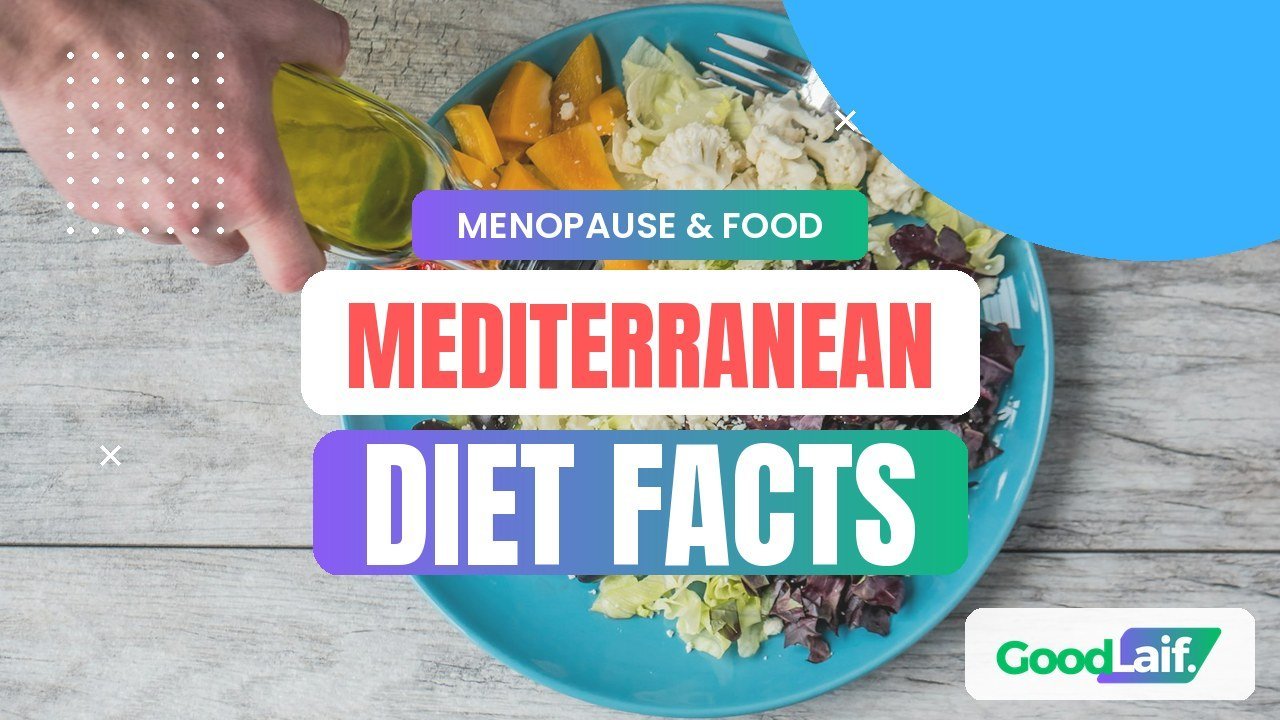
The Mediterranean diet for menopause weight loss has a catch that headlines rarely mention. In one small Italian study, women lost body fat on a Mediterranean-style plan, but the plan also built in a daily calorie deficit of 500 to 600 kcal. So the olive oil and fish may not have done all the work.
Here is what the research really shows, what it cannot show, and how to use the pattern in a realistic way after 40.
This article is for general education and is not medical advice. Please read our Medical Disclaimer and talk to your own clinician about your health.
What the Mediterranean Diet Includes
Mayo Clinic describes the Mediterranean diet as one that is most often high in vegetables, fruits, whole grains, beans and legumes, nuts and seeds, extra virgin olive oil, and herbs and spices. It suggests fish or shellfish at least 2 to 3 times a week. It also advises limiting red meat and foods with added sugar.
Notably, Mayo Clinic’s overview focuses on heart health. Its stated benefits are lower risk factors such as high cholesterol and high blood pressure. It makes no body-weight promise. That matters, because many blog posts do.
Mayo Clinic also adds a practical point: research suggests it is important to follow the pattern over the long term. In other words, this is a way of eating, not a two-week reset.
What One Study Found About Fat Loss After Menopause
The most useful trial for this topic is a 2020 study in the journal Nutrients. Researchers at a nutrition clinic in Rome followed 89 women with a mean age of 52.8 years. Some were menopausal, and some still had regular cycles. Everyone followed the same plan for two months.
The plan was a Mediterranean-style diet with a deficit of 500 to 600 kcal per day. It included 25 to 35 g of olive oil and 20 g of nuts daily, fish at least twice a week, and red meat no more than twice a week. A dietitian saw participants twice a month.
Across the whole group, fat mass fell by an average of 2.3 kg (p < 0.001). Fat-free mass fell by 0.7 kg on average. The authors concluded that menopausal women could lose fat mass in the same way as younger women on this plan.
The study also noted that LDL cholesterol dropped more in the menopausal group, by 28.2 mg/dL compared with 7.7 mg/dL in women with regular cycles.
Why You Should Read That Result Carefully
First, the diet included a planned calorie deficit. Therefore, the result tells us that a Mediterranean-style plan can work when calories are reduced. It does not prove the food pattern alone melts fat.
Second, the study had no untreated control group. Third, the authors themselves say the sample was relatively small and that participants should have been studied for longer. Two months is a short window.
Does the Diet Ease Menopause Symptoms Too?
A 2022 paper in Frontiers in Endocrinology looked at a related question. Researchers in Naples studied 100 postmenopausal women with obesity, with a mean age of 57.2 years. They measured how closely each woman followed a Mediterranean diet and scored her menopausal symptoms.
Women with marked symptoms had a significantly lower diet score than women with none to moderate symptoms (p = 0.036). In addition, higher legume intake was linked with a lower symptom class, and olive oil intake was linked with fewer psychological symptoms.
However, this was a cross-sectional study. The authors state that it could not show cause and effect. The women came from a single clinic, too. So the finding is a clue worth testing, not a promise.
How to Use the Mediterranean Diet for Menopause Weight Loss
Based on what the sources support, here is a sensible, modest way to begin. None of this replaces advice from your own clinician or dietitian.
- Build plates around vegetables and legumes. Beans, lentils and chickpeas show up in the Mayo Clinic pattern and in the symptom study above.
- Cook with extra virgin olive oil. The Rome plan used 25 to 35 g a day, but you should measure it. Oil is energy-dense.
- Eat fish 2 to 3 times a week. This follows the Mayo Clinic guidance.
- Keep red meat and added sugar low. Both are on Mayo Clinic’s limit list.
- Watch portions. The trial’s results came with a calorie deficit, so quantity still counts.
- Add protein and movement. Our guide to protein for women over 40 and our tips on how to speed up metabolism after 40 cover two pieces this diet does not handle alone.
A word on alcohol. Mayo Clinic says alcohol is optional, and that for overall health you should drink one or fewer drinks a day. It also says that if you do not drink, you should not start for health reasons.
Common Mistakes to Avoid
It is easy to assume that “Mediterranean” means any food with olive oil on it. Yet pasta, bread and sweets are not the heart of the pattern. Likewise, nuts and oil are healthy, but they add up quickly.
Another trap is expecting fast results. The Rome study lasted only two months, and Mayo Clinic stresses long-term adherence. Consistency beats perfection.
If belly fat is your main concern, you may also want to read foods to avoid for menopause belly fat. For a broader look at why the scale moves in midlife, see perimenopause weight gain symptoms.
FAQ: Mediterranean Diet for Menopause Weight Loss
Can the Mediterranean diet help you lose weight during menopause?
It can support fat loss when paired with a calorie deficit. In a 2020 Nutrients study of 89 women, a Mediterranean-style plan with a 500 to 600 kcal daily deficit reduced fat mass by 2.3 kg on average over two months. The study had no untreated control group.
Does the Mediterranean diet reduce menopause symptoms?
The evidence is early. A 2022 study of 100 postmenopausal women found that those with marked symptoms had lower Mediterranean diet scores. Because it was cross-sectional, it cannot prove that the diet reduces symptoms. More controlled research is needed.
What foods are in the Mediterranean diet?
Mayo Clinic lists vegetables, fruits, whole grains, beans and legumes, nuts and seeds, extra virgin olive oil, and herbs and spices. Fish is suggested at least 2 to 3 times a week, while red meat and added sugar are limited.
Your Next Step
This week, swap one meal for a legume-and-vegetable plate cooked with a measured spoon of olive oil. Small, repeatable changes are the point. If you would like gentle, practical support, you can Join the GoodLaif Community and get our set of 50 diet motivation graphics as a thank-you.






+ There are no comments
Add yours